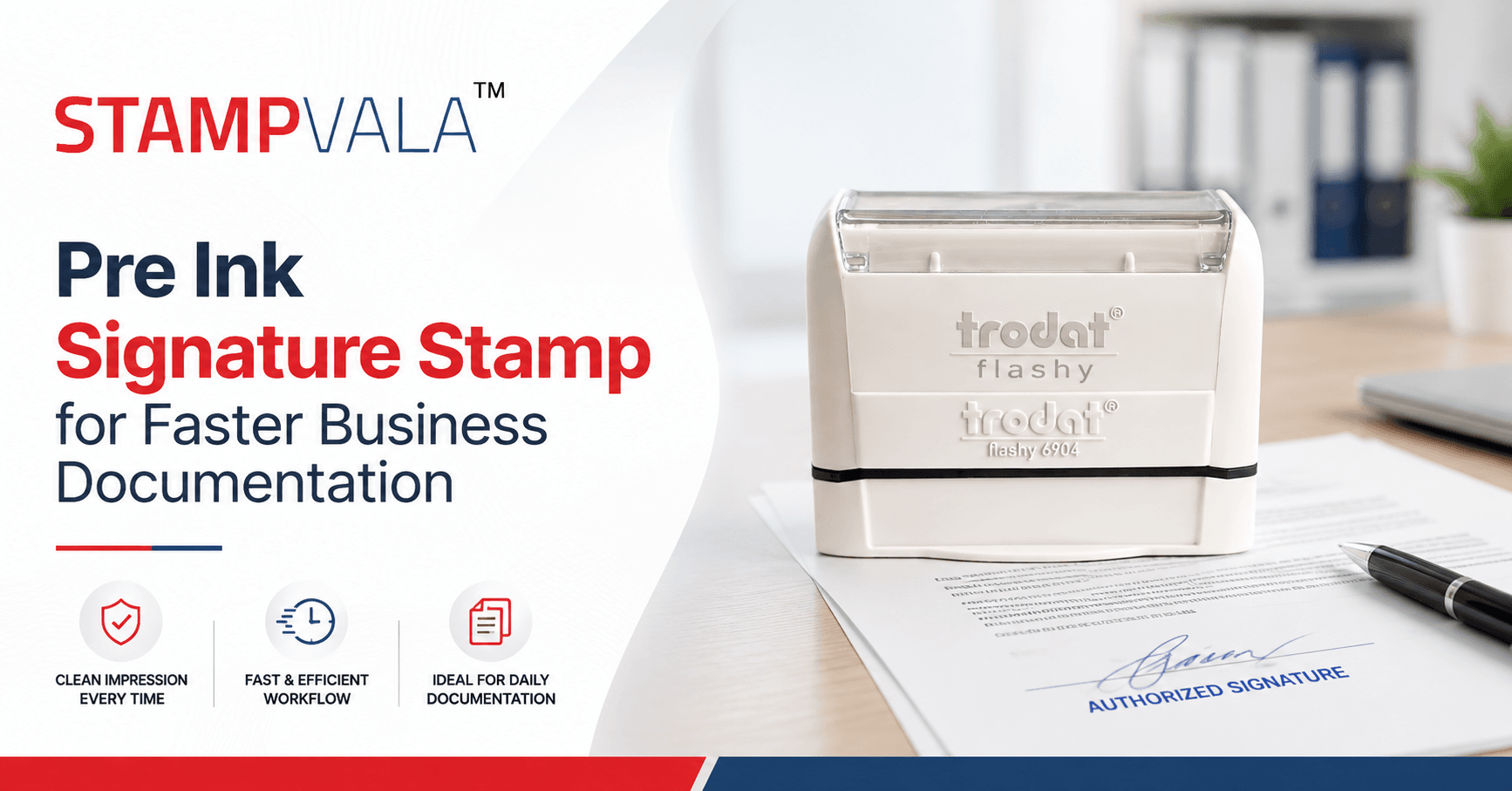
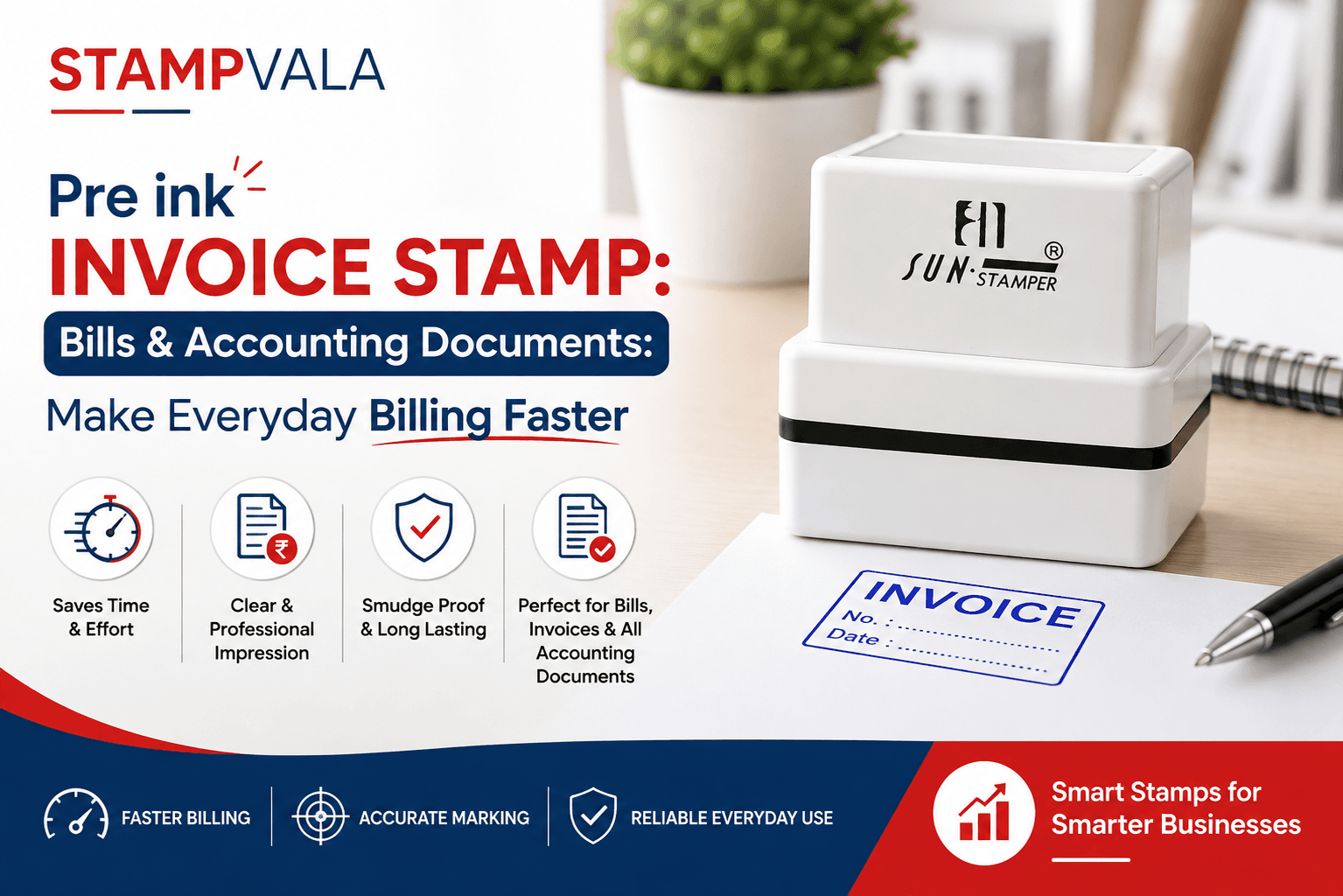
Pre ink invoice stamp helps businesses process invoices, bills, vouchers, receipts, and accounting records faster, without unclear or inconsistent impressions. The built-in ink eliminates the need to carry an ink pad, making it easy for accounts teams that handle paperwork throughout the day. Companies can tailor an invoice stamp with company information, payment status, verification notes, approval details, or any other commonly needed text.
For retail outlets and wholesalers, accounting firms, and corporate offices, the right stamp can save time and effort on duplicating financial records and simplify the organization’s daily financial records by making them orderly and more professional.
Why Use a Pre Ink Stamp for Invoices and Bills?
Billing and accounting teams focus on repetitive documentation on a day-to-day basis. The same notes, details of the company, payment position or verification record might need to be included in dozens of invoices and records.
Manually writing these details creates inconsistencies across documents and is time-consuming. The pre-ink invoice stamp lets employees quickly replicate commonly used information with one stamp.
It can be especially useful for businesses processing:
- Sales invoices
- Purchase invoices
- Bills
- Payment vouchers
- Receipts
- Credit and debit notes
- Expense documents
- Internal accounting records
The purpose is not to replace proper accounting controls. Instead, a customised stamp helps simplify repetitive marking and makes documents easier to process and identify.
Where Can Businesses Use a Pre Ink Invoice Stamp?
An invoice stamp can serve different purposes depending on how a company’s billing and accounting workflow is structured. Rather than using one stamp for everything, businesses can create stamps around the information their teams repeatedly add to documents.
Invoices and Sales Bills
Invoices frequently go through various processes prior to being documented or forwarded to the clients. A company-specific billing stamp can include information frequently needed by the company, or internal notes, without employees having to type the same text repeatedly.
This comes in handy especially for retailers, distributors, manufacturers, wholesalers, and other businesses that produce multiple invoices per day.
Purchase Bills and Vendor Invoices
Vendor bills that are received are typically supposed to be verified, authorized, processed or sent to accounts. A stamp with the comment RECEIVED, VERIFIED, CHECKED, or APPROVED can simplify employees’ identification of the document’s current status.
An accounting stamp can underpin a more systematic internal paperwork flow, particularly when a document moves between more than one employee or department.
Payment and Expense Documents
Internal standard remarks may be required on payment vouchers, expense records, reimbursement forms, and other documents.
In lieu of writing the same status again and again, accounts teams can apply customised stamps to documents to determine the documents that have traversed a given internal process.
Popular Invoice and Accounting Stamps Businesses Can Customise
No single design fits every business. The right stamp depends on your accounting process and the information employees repeat most often.
Common options include:
- PAID
- RECEIVED
- APPROVED
- VERIFIED
- CANCELLED
- ACCOUNTS CHECKED
- PAYMENT RECEIVED
- AUTHORISED
- ORIGINAL
- DUPLICATE
- Company Name and Address
- Custom Accounting Remarks
A pre ink invoice stamp can also be customised with multiple lines when more detailed information is required.
The important part is keeping the impression clear. Adding every possible piece of information to one stamp usually creates an overcrowded design that becomes harder to read.
How a Pre Ink Invoice Stamp Improves Accounting Workflow
A stamp may be a small office tool, but repetitive tasks are exactly where small efficiencies can matter.
Faster Document Processing
When an accounts worker must type PAID, VERIFIED, or some other typical statement more than dozens of papers, each little effort adds up.
A pre-ink stamp lets you copy the same information at once, without opening an ink pad or rewriting the text. In companies that have to work with paperwork on a daily basis this can streamline the paperwork process.
Consistency Across Records
Handwritten notes may be processed differently. A single employee can shorten a word and another writes differently.
The same wording and layout are generated each time a customised accounting stamp is used. This consistency can make internal records easier to identify and keep.
Cleaner Business Documentation
Poorly drawn handwritten commentary can make otherwise well-prepared invoices or records look untidy. A professionally developed stamp produces a consistent, clean impression.
This is especially important when an invoice stamp appears on documents that customers, vendors, or other external parties may view.
No Separate Ink Pad
In pre-ink stamps, the ink is embedded within the stamp. Accounts teams can store the stamp at their workstation and use it as needed without constantly reaching for a separate ink pad.
This makes stamping uncomplicated in normal office use and reduces the cluttered look of stamps around billing office areas.
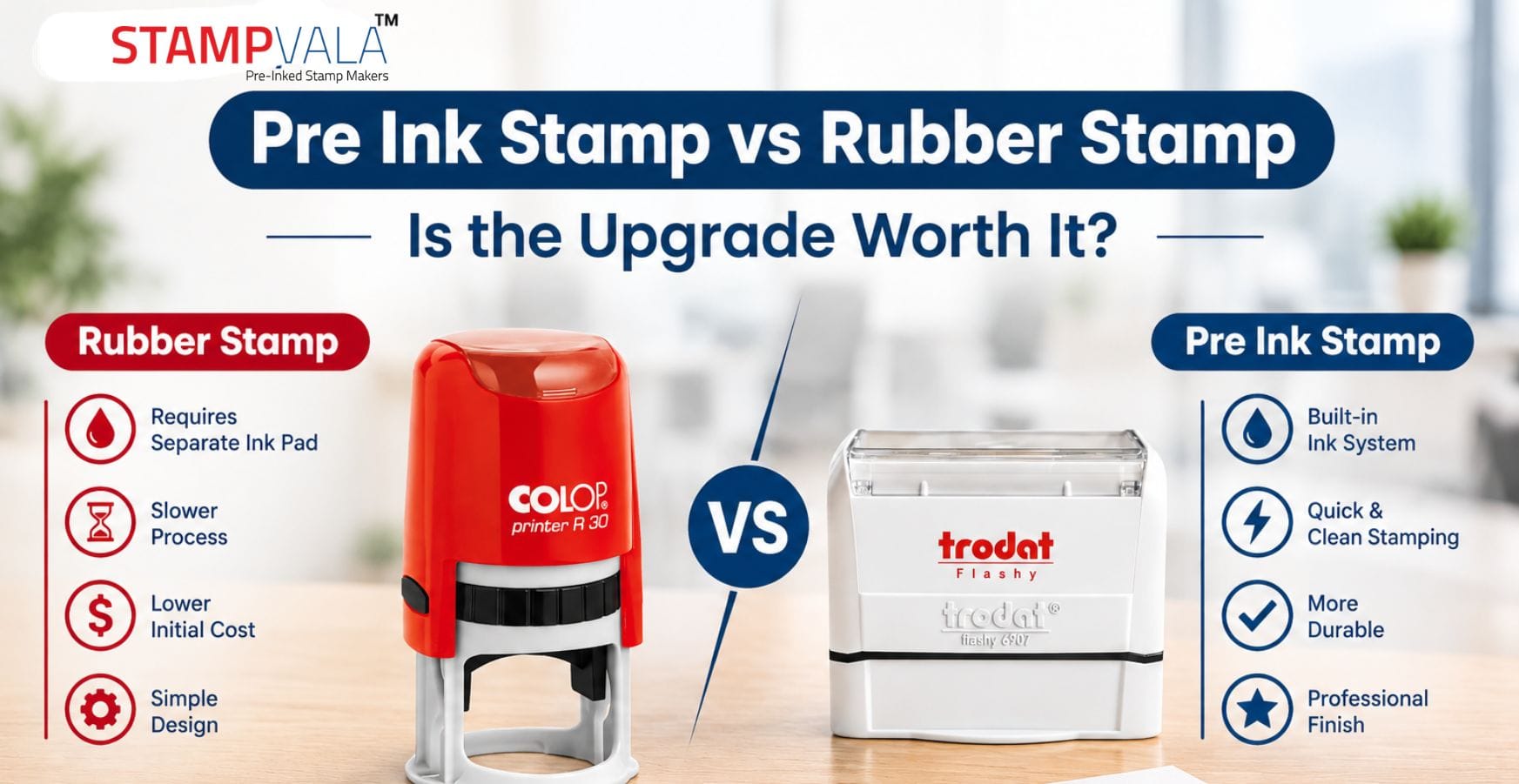
Pre Ink Stamp vs Traditional Rubber Stamp for Accounting Work
Both stamp types can work for business documentation, but the better choice depends on frequency of use and the type of impression required.
| Feature | Pre Ink Stamp | Traditional Rubber Stamp |
| Ink | Built in | Separate pad |
| Daily Use | Convenient | More manual |
| Impression | Detailed and consistent | Depends on inking |
| Multiple Lines | Well suited | Suitable |
| Portability | Easy | Stamp + pad required |
| Best For | Regular professional use | Occasional use |
For detailed company information or customised accounting text used regularly, a pre ink stamp offers a convenient alternative to the traditional stamp-and-pad setup.
Which Businesses Can Benefit From Invoice and Accounting Stamps?
Almost any business handling regular billing can use customised stamps, but they become particularly valuable when document volumes increase.
They are useful for:
- Retail stores
- Wholesalers and distributors
- Manufacturers
- Chartered accountants
- Accounting firms
- Corporate offices
- Logistics companies
- Warehouses
- Service businesses
- Educational institutions
- Clinics and hospitals
- Small and medium businesses
For a small company, one billing stamp may be sufficient. Larger businesses may use separate stamps for accounts, purchase, administration, and payment processing.
The goal should always be to match each stamp to an actual recurring task rather than ordering unnecessary stamps.
What Should You Put on Your Pre Ink Invoice Stamp?
Before ordering, identify exactly what employees currently write repeatedly.
If the problem is payment identification, a simple PAID or PAYMENT RECEIVED stamp may be enough. If your team repeatedly adds business information, a customised company details stamp may provide more value.
Depending on the purpose, your stamp can include:
- Company name
- Address
- Custom billing remark
- Payment status
- Verification status
- Department name
- Short internal instruction
- Authorised designation
- Date field where appropriate
Avoid including sensitive information simply because space is available. A pre ink invoice stamp should simplify the document, not make it unnecessarily complicated.
How to Choose the Right Pre Ink Stamp for Accounting Documents
Begin with how much of the information you are required to reproduce. Companies will find it easier to include short remarks in a smaller stamp, while more accounting information needs a bigger impression area with multiple lines of text.
Also think over the usage of the stamp by the employees. When it is seen on documents during the working day, durability and consistency of impressions will be more significant than merely selecting the most affordable one.
For more elaborate designs, ensure the text is readable at the final impression size. A larger stamp with clean lines is better than cramming several lines into a small space.
Conclusion
Invoicing and accounting documents are required to be processed over and over again; hence, any little improvement can help make the daily office task smoother. The use of pre ink invoice stamp ensures that businesses can duplicate the common information very fast and also have clean and standard impressions on the bills, vouchers, receipts and the accounting books.
The right stamp depends on your workflow. Some businesses might need PAID or VERIFIED stamps, while others can use personalized company information or accounting comments.
No need to spend hours writing the same information over and over again; just pick a stamp that has a design based on the task that your team does daily.
Explore Stampvala’s Pre-Ink Stamps and customise your invoice, billing, or accounting stamp for faster and more professional business documentation.
Frequently Asked Questions
1. What is a pre ink invoice stamp?
A pre ink invoice stamp is a customised stamp with ink incorporated into the stamp itself. Businesses use it to reproduce commonly required information or remarks on invoices, bills, vouchers, and other accounting documents.
2. What can I include on an invoice stamp?
An invoice stamp can contain company details, payment status, verification remarks, department information, or customised text such as PAID, RECEIVED, APPROVED, VERIFIED, or PAYMENT RECEIVED, depending on your business workflow.
3. Is a pre ink stamp suitable for daily accounting work?
Yes. Pre-ink stamps are convenient for regular office documentation because they don’t require a separate ink pad and create consistent impressions across frequently processed accounting records.
4. Which accounting stamps should a business have?
The right accounting stamp depends on the company’s processes. Common choices include PAID, RECEIVED, VERIFIED, APPROVED, ACCOUNTS CHECKED, PAYMENT RECEIVED, and customised company information stamps.
5. Can I customise a billing stamp for my business?
Yes. A billing stamp can be customised according to your required text, company details, impression size, and layout. Keeping the design limited to information your team genuinely uses will usually produce the clearest result.

